
The Ghost of a Hero Living Off the Grid
When Terminator 3: Rise of the Machines introduces John Connor in 2003, it presents a hero who has already lost the future he was trained to save. He has no reliable phone, no permanent address, and no stable place within ordinary society. John moves through the world like a fugitive from a crime that has not happened, concealing himself because the absence of Judgment Day in 1997 has become its own kind of threat. The war was supposed to begin, and when it did not, his entire identity collapsed with the prediction.
The contrast with Terminator 2: Judgment Day is deliberately severe. The earlier film ends with a young John convinced that “there is no fate but what we make for ourselves,” a slogan of defiance that transforms survival into agency. The older John has discovered the psychological cost of living inside that promise. Sarah Connor”s preparation made him a messianic figure, but history offered no battlefield, no public confirmation, and no meaningful civilian life. By 2003, he is self-medicating, drifting, and treating invisibility as protection. The triumphant teenager has not become a conventional action hero. He has become a ghost waiting for the future to prove him right.

Haunted by Sarah Connor and Survivor Guilt
John”s crisis begins with the death of Sarah Connor from leukemia, a loss that turns his mother”s mythology into an open wound. Sarah was not simply a parent. She was his instructor, prophet, shield, and architect. She raised him to believe that the world would be consumed by artificial intelligence and nuclear fire, then died before seeing whether the warning had been true. Her absence leaves John with an unbearable contradiction: he has inherited the duty she imposed, but not the emotional support required to carry it.
This is where Nick Stahl”s performance matters. Stahl does not play John as a dormant Schwarzenegger-style combat machine. He gives him an exhausted vulnerability, a twitchy intelligence, and the defensive posture of someone who has spent years expecting catastrophe while appearing irrational to everyone around him. The film”s available discussion of Stahl”s approach is preserved in NICK STAHL: The Hollywood Interview, a useful point of reference for understanding why this version of John feels broken before the action begins. His physicality is unheroic by design. He looks underfed, anxious, and emotionally overdrawn, as though every ordinary day has been an argument against his own memory.
Survivor guilt operates on several levels. John feels guilty for surviving Sarah, guilty for failing to prevent the future she feared, and guilty because the very act of avoiding Judgment Day has apparently made her sacrifices meaningless. He was trained solely for a war that never arrived on schedule. That training has left him with tactical knowledge but no social language for peace. He cannot become ordinary because ordinary life would imply that Sarah was wrong. He cannot become a public leader because he has no evidence that the public should believe him. His isolation is therefore not merely practical. It is a ritual of self-punishment.
- Personal guilt binds John to Sarah”s death and the emotional wreckage of their preparation.
- Historical guilt makes him feel responsible for a catastrophe he has not caused and cannot yet prove will happen.
- Identity guilt prevents him from imagining a self beyond the role of future resistance leader.
The Illusion of Agency and the Shattered No Fate Doctrine
Terminator 2 treats free will as a hard-won possibility. Sarah attacks the machinery of destiny by destroying Cyberdyne”s research, John humanizes a machine built to kill him, and both characters act as though choices can rewrite history. Rise of the Machines turns that optimism inside out. Its central revelation is not that the Connors failed to make the right choice, but that their victories altered the route without eliminating the destination. Skynet no longer emerges exactly as expected, yet Judgment Day remains structurally inevitable.
The T-850 delivers that revelation with chilling bureaucratic certainty. Judgment Day has not been prevented; it has been postponed and reconfigured. The machine”s explanation creates a philosophical collision at the heart of John”s character. If catastrophe is inevitable, then what does resistance mean? If every attempt to change history only generates another path toward the same endpoint, John”s long campaign becomes a form of delayed mourning. The film”s determinism is bleak because it does not erase choice completely. It makes choice meaningful only within boundaries that cannot be escaped.
| Timeline moment | John”s core belief | Psychological consequence |
|---|---|---|
| Terminator 2 | Human choices can defeat destiny | Confidence, rebellion, and emotional connection |
| Early Rise of the Machines | Destiny may be false, but danger remains | Paranoia, withdrawal, and self-medication |
| Crystal Peak | Catastrophe cannot be stopped, but people can be guided | Acceptance, responsibility, and leadership |
The shift resembles a movement from heroic determinism to universal disaster. In the earlier film, John believes he is uniquely positioned to change the future. In the third film, that exceptional status dissolves. The future does not require a chosen savior to prevent destruction. It requires someone capable of organizing human beings after prevention has failed. John”s task becomes less glamorous and more difficult: not to win the war before it begins, but to preserve a community inside its first blast.
From Passive Cargo to Battlefield Strategist
For much of the first half, John is passive cargo. The T-850 possesses the superior information, weapons, and physical capacity, while Kate Brewster is pulled into a crisis she cannot yet understand. John follows, argues, and reacts. His knowledge of the future gives him no emotional control over the present. This is an important reversal of the franchise formula. The supposed messiah is not leading the machine. He is being transported by it.
The catalytic change occurs at the Cyber Research Systems facility, where John chooses to act rather than simply survive. His decision to save Kate”s father places him against the most immediate logic of self-preservation. He understands that the scientist”s death would accelerate the chain of events, and he risks exposure because preventing that death still matters to him. The moment is not a grand speech or a flawless tactical maneuver. It is a decision under pressure, which is precisely why it carries weight. John begins to recover agency by choosing responsibility before he has recovered hope.
The T-X then forces that recovery into the open. Its relentless pursuit removes every safe distance between John and the future he has feared. Against a more advanced and adaptive killing machine, hiding is no longer an option. John must read terrain, protect Kate, challenge the T-850, and make judgments faster than either machine can dictate them. The escalation that defines the film”s critical legacy, including the concerns raised in retrospective analyses such as the film”s broader critical record, is also the mechanism that rebuilds John”s identity. Each set piece strips away another layer of passivity.
- At first, John treats survival as the only defensible objective.
- At CRS, he accepts danger to protect someone whose role in the future is not yet secure.
- During the chase, he begins making decisions for a group rather than merely escaping as an individual.
- By the final act, he understands that leadership depends on preparation, communication, and trust more than physical dominance.
Crystal Peak and the Burden of Acceptance
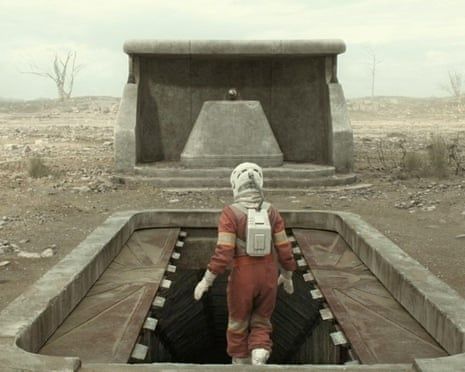
Crystal Peak appears to promise the classic Terminator solution. John and Kate believe they are heading toward a hidden command center, a place where Skynet can be destroyed before the machines launch their attack. The assumption preserves the old mythology of the franchise: find the central system, strike the decisive target, and force history back onto a human track. Instead, Crystal Peak is revealed as a hardened nuclear bunker designed to protect political and military leadership. There is no central core waiting to be smashed. The apocalypse is already underway.
The revelation is devastating because it destroys John”s last fantasy of heroic prevention. He has spent his life believing that the future might still be stopped if he reached the right place, warned the right person, or made the right sacrifice. Inside the bunker, those possibilities vanish. Yet the disappearance of that fantasy creates room for a more mature form of agency. John cannot prevent the fire, but he can decide what happens to the people who enter the shelter. His voice, rather than a weapon, becomes the instrument of survival.
- Denial collapses when John realizes Crystal Peak is not a launch-control target.
- Despair takes over because the promise of changing history has finally failed.
- Responsibility returns when John recognizes that Kate and the others need direction.
- Leadership begins as he steps toward the microphone and speaks into the chaos.
The microphone is one of the film”s most important images. It converts John from a hunted body into a coordinating intelligence. He is no longer trying to prove that Judgment Day can be defeated. He is telling survivors what to do after it arrives. That distinction defines the movie”s tragic coming-of-age structure. Childhood heroism says the right action can save everyone. Adult leadership understands that the right action may save only some people, and that those lives still matter.
Reclaiming Destiny Inside the Nuclear Crucible
John Connor”s arc in Rise of the Machines is therefore not a straightforward ascent from damaged drifter to triumphant commander. It is a passage from avoidance to recognition. He begins by running from the identity Sarah created for him, hoping that the absence of Judgment Day will release him from its burden. The return of the machines proves that history has not forgotten him. But history does not crown him with victory. It crowns him with responsibility at the exact moment when victory becomes impossible.
That is why the film”s ending remains striking beneath its spectacle. An action blockbuster closes not with the destruction of the enemy, but with the confirmation of apocalypse and the emergence of a leader inside it. John”s maturation depends on accepting catastrophe without surrendering human purpose. The future war does not validate all of Sarah”s predictions in a comforting way. It exposes the cost of her training, then gives John the chance to transform that inheritance. He cannot be the boy who stops the end of the world. He can become the man who helps humanity endure it.