
The Synthetic Nightmare That Defined 1984 Cinema
When James Cameron”s The Terminator arrived in 1984, its terror did not come from scale alone. The film had a lean, hard-edged visual language, but its soundscape made the future feel physically present. Every appearance of the machine carried an acoustic signature that seemed to come from inside its metal skeleton: blunt impacts, unstable pulses, electrical pressure, and synth tones stripped of warmth. The score did not decorate the action. It functioned like the machine”s nervous system.
Brad Fiedel reached that effect by rejecting the reassuring grammar of conventional orchestral science fiction. Rather than building dread through swelling strings and grand brass, he used early synthesizers, sequencers, sampled sounds, and deliberately imperfect loops. The result was partly a consequence of technological limitation, but limitation became a creative weapon. For production context and personnel details, the soundtrack history documented by The Terminator soundtrack record provides an essential reference point. Fiedel”s score sounds less like music performed around a machine than a machine discovering rhythm.
Accidental Genius and the Polyrhythmic Pulse of 13/16
The central theme”s most famous gesture is a repeated mechanical thud, a five-part impact pattern that seems to march forward while constantly threatening to stumble. It is not the clean, square propulsion of a typical action cue. The beat advances, but its weight distribution keeps shifting. That instability creates the sensation of a hunter whose body is perfectly controlled yet impossible for human instincts to predict.
The mystery deepens because the rhythm was not born from a neatly notated score. Fiedel developed the material through improvisation with early synthesizers, sequencers, and sampled frying-pan sounds. A loop was recorded slightly off-meter, and the equipment did not automatically correct the timing. Instead of repairing the irregularity, Fiedel recognized its forward-driving force and preserved it. Later analysis identified a possible 13/16 organization, grouped as three plus three plus three plus two plus two, while other listeners hear alternating meters or related subdivisions. A detailed account of the debate appears in Slate”s investigation of the score”s elusive time signature.
That distinction matters because standard 4/4 timing creates a dependable contract with the listener. The body knows where the next downbeat belongs. Fiedel”s pattern breaks that contract without becoming shapeless. Its groupings are precise, but they do not resolve in the way a pop groove or symphonic march normally would. The theme therefore produces a special kind of psychological terror: the listener can follow the machine, but cannot comfortably inhabit its movement.
- Regular meter creates predictability, making action feel coordinated and legible.
- Asymmetric meter creates forward motion with an embedded threat of imbalance.
- Fiedel”s loop combines repetition with dislocation, making each return feel familiar and newly dangerous.
The rhythm also connects directly to the film”s mythology. The Terminator is a weapon built to pursue a target through time, yet it moves through human environments with alien timing. Its footsteps, attacks, and pauses do not belong to ordinary bodily rhythm. The score turns that difference into structure. The machine is not merely accompanied by an unusual beat; the unusual beat is the machine”s behavior translated into sound.
Cast-Iron Cookware and Prophet Synths Over Redundant Brass
Fiedel”s instrumentation is crucial to the score”s physical credibility. The famous percussion was not simply a polished orchestral effect. Cast-iron skillets were struck with drumsticks, producing dense, blunt attacks with a hard metallic body. Those sounds possess flaws that a conventional percussion section might try to eliminate: irregular resonance, abrasive overtones, and an impact that feels close enough to touch.
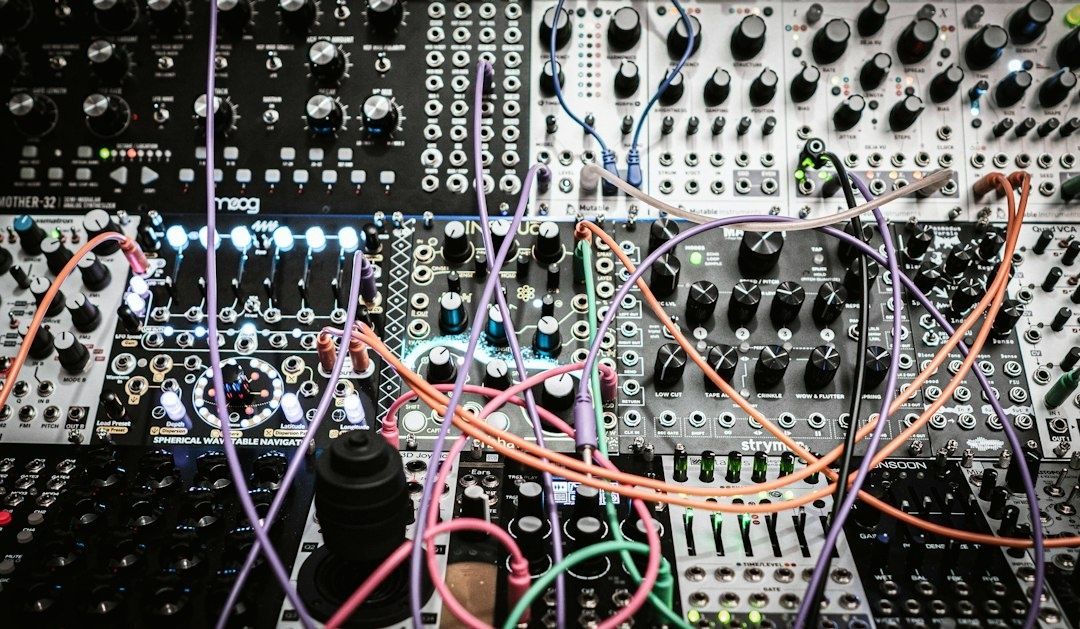
Against those acoustic strikes, Fiedel layered Prophet-10 and Oberheim synthesizers. Their tones do not imitate a human voice or a romantic string section. They suggest cold surfaces, electrical systems, and chrome under pressure. The analog circuitry gives the score a slight instability, a sense that the sound is alive because its voltage is alive. This is one reason the music remains tactile even when its materials are electronic.
The acoustic-industrial fusion also avoids a common weakness in modern blockbuster scoring. Large symphonic productions can deliver tremendous power, but power is not the same as menace. Strings doubled across enormous sections, brass compressed into heroic blasts, and low-end impacts stacked beneath every edit can make danger feel pre-announced. Fiedel”s sound world is narrower and harsher. It leaves exposed gaps, allows noise to remain noise, and makes each impact carry narrative weight.
- Cast iron provides the machine”s physical violence.
- Analog synthesizers supply its electronic interior and inhuman coldness.
- Asymmetrical sequencing turns motion into pursuit rather than spectacle.
- Silence and restraint preserve space for the viewer”s imagination to generate fear.
This philosophy belongs to the broader industrial tradition, in which found sounds, loops, distortion, and mechanical repetition expand the definition of musical material. Yet Fiedel never allows the score to become an abstract exercise. Every texture serves the story. The machine”s sound must remain intelligible as pressure, impact, and threat. The music is experimental, but its dramatic purpose is brutally clear.
Soundtrack Anatomy Comparing Terminator Eras
The early Terminator scores are architectural systems rather than collections of decorative themes. Their identity comes from the relationship between rhythm, texture, and narrative function. Later orchestral entries often pursue scale first, using familiar blockbuster vocabulary to signal heroism, catastrophe, or emotional uplift. The comparison is not a judgment against orchestral writing itself. It is a question of whether the chosen musical architecture belongs to the world on screen.
| Element | Early Fiedel approach | Modern orchestral approach | Dramatic result |
|---|---|---|---|
| Thematic identity | Short, forceful motifs with unstable repetition | Broader melodic statements and thematic swells | Machine threat becomes either immediate or generalized |
| Instrumentation | Analog synths, found percussion, sequenced pulses | Large string, brass, percussion, and hybrid ensembles | Cold tactility gives way to cinematic mass |
| Rhythm | Asymmetric groupings and mechanical lurches | More regular action meters and synchronized impacts | Unpredictability is reduced |
| Dread factor | Intimate, abrasive, and bodily | Expansive, polished, and often heroic | Fear can be displaced by spectacle |
The contrast is especially sharp in the treatment of the machine war. Fiedel”s music suggests that Skynet is not a distant army but an intelligence embedded in infrastructure, circuitry, and industrial motion. A later orchestral score may describe the war as a monumental event, but monumentality can make the threat feel safely mythic. The original makes it feel local. The danger is in the alley, behind the door, and inside the sound system.
The Corporate Orchestral Trap from Rise of the Machines Forward
Terminator 3 Rise of the Machines marks a creative pivot toward the safer symphonic language that increasingly defined franchise action cinema. The shift was understandable. By that point, the series carried larger budgets, more elaborate set pieces, and the commercial expectation of a polished event film. But polish changes the dramatic temperature. When synthetic dissonance is replaced by familiar brass surges and orchestral momentum, the machine begins to sound less like an invading intelligence and more like a standard action antagonist.
The problem is not that orchestras lack menace. Composers from Bernard Herrmann to modern horror specialists have used orchestral instruments with extraordinary violence. The problem is standardization. A brass crescendo can signify danger, triumph, revelation, or impending sacrifice. Fiedel”s metallic pulse is more specific. It belongs to an industrial nightmare with its own physics. Once the score adopts generalized blockbuster gestures, the franchise risks losing the distinction between a Terminator and any other digitally enhanced threat.
Later entries often intensified the visual spectacle while weakening the sound”s sense of contamination. Explosions became larger, chase sequences became more elaborate, and the future war received increasingly polished treatment. Yet the original score”s terror came from refusing to make the future beautiful. Its textures were damaged, compressed, and strangely intimate. They suggested a world where technology had not merely conquered civilization, but had altered the rhythm by which civilization understood danger.
- Identify the machine”s physical material. Is it steel, circuitry, hydraulic pressure, corrupted data, or something else?
- Build a rhythm that belongs to that material. A machine should not automatically move in the same meter as a human hero.
- Preserve sonic irregularity. Small imperfections can communicate more threat than layers of flawless impact design.
- Separate spectacle from dread. A louder cue is not necessarily a more frightening cue.
- Let silence remain active. The absence of sound can make the next mechanical strike feel inevitable.
The lesson extends beyond the franchise. Contemporary tools make it easy to create enormous hybrid scores, with vast sample libraries, processed percussion, sub-bass impacts, and synchronized electronic pulses. But abundance can erase identity. Industrial music libraries now offer thousands of loops, samples, drones, transitions, and cinematic effects, yet authenticity still depends on selection, timing, and restraint. The crucial question is not whether a production can sound expensive. It is whether the sound possesses a point of view.
Restoring the Relentless Machine to Future Soundtracks
Authentic dystopian science fiction needs more than orchestral comfort. It needs a sonic logic that makes technology feel alien, invasive, and physically consequential. Brad Fiedel”s achievement was not simply the use of synthesizers or unusual time signatures. It was the conversion of production accidents into mythology. A mistimed loop became the pulse of a killing machine. A struck pan became the impact of steel. An analog tone became the voice of an intelligence without empathy.
Future franchise sound designers should treat that legacy as a challenge rather than a template. Recreating the 1984 score note for note would miss its central principle. The goal is not to imitate the surface of Fiedel”s work, but to recover its courage: use imperfect rhythms, hostile textures, unexpected instruments, and silence to make the threat specific. When the music stops trying to sound grand and starts sounding inevitable, the machine returns. Spectacle can show the future war. A truly dangerous score makes the listener feel that the war has already entered the room.